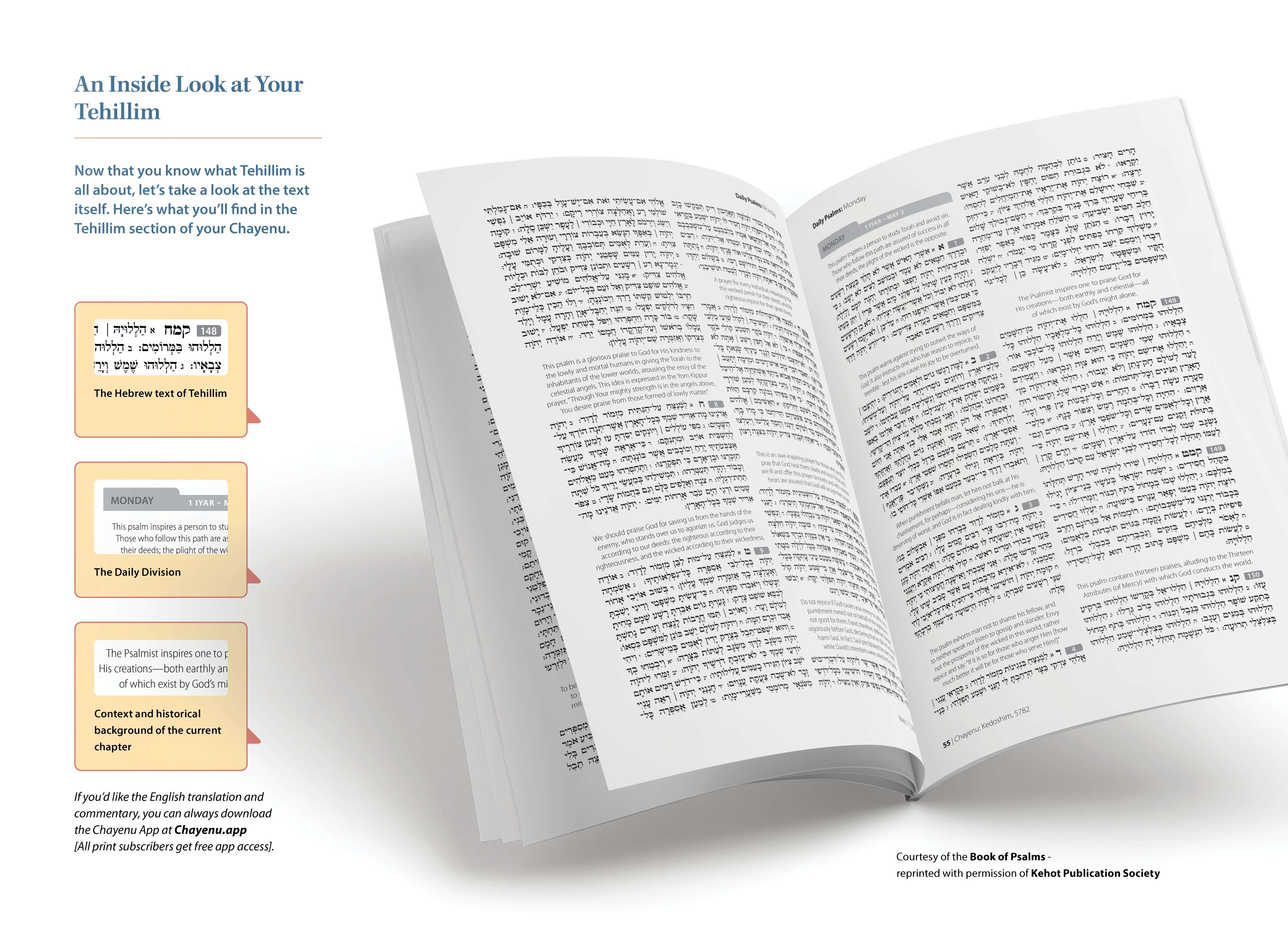
Tehillim
Recite daily for inspiration and connection to G-d from the Book of Psalms, which was compiled and authored by King David, in praise and supplication to G-d.
“...The chapters of Tehillim break through all barriers as they soar aloft, higher and higher, uninterrupted. They prostrate themselves before the Master of the Universe, bringing results with kindness and mercy.”
The Power of Tehillim#
Tehillim opens the gates of heaven to our most heartfelt prayers. Tehillim comforts, and Tehillim heals. Time and again, Tehillim saves lives.
Tehillim has seen us through thousands of years of history, revealing its power throughout the ages. Today, in the 21st century, Tehillim continues to be crucially relevant and necessary.
What is Tehillim?#
King David’s 150-chapter Biblical book of Tehillim (Psalms) is divided in a number of ways. It is split into five books, which correspond to the Chumash (Five Books of Moshe), while it is also divided into seven parts so that it can be completed over the course of a week.
An alternative division creates a monthly cycle, in which only a few chapters are read each day and the entire book of Tehillim is completed on the final day of each Jewish month. During months containing twenty-nine instead of thirty days, the thirtieth portion is combined with the twenty-ninth portion.
Not just poetry#
King David said: “May the words of my mouth and the meditation of my heart be acceptable before You” (Psalms 19:15).
Prepare the words of Psalms and inscribe them for future generations, and it should not be read like one reads poetry; rather, it should be read diligently (Midrash Tehillim 1).
It’s your experience#
Everything that David said in his book of Psalms, he said for his own experience, the Jewish people’s experiences, and for the experiences of all times (Midrash Tehillim 18).
In depth Torah study#
King David asked of G-d: Please, when they recite Psalms, they should get rewarded as if they were studying the complex sections of law—those dealing with leprosy and impurity imparted through a tent (Midrash Tehillim 61).
Reciting Tehillim Daily#
Tehillim as part of Chitas#
The second stage of Chitas, the saying of Tehillim, was initiated in the midst of a perilous period for Chabad and indeed, for much of Jewry. The Soviet establishment launched an oppressive campaign in all the territories under its vast dominion with the design of suffocating every last vestige of the Jewish soul—Torah education, belief in G-d, and the practical observance of the mitzvos.
Despite the far reach of their secret police and the sheer terror of their ruthless methods, the Communists discovered that a lone citizen was successful in consistently and methodically unwinding their evil designs on a massive scale.
That man was Rabbi Yosef Yitzchok Schneersohn, the Rebbe Rayatz, who formed and personally directed a breathtaking labyrinth of underground Torah schools, synagogues, mikvahs, and the like. He sent overt and covert emissaries, teachers and instructors who were willing to risk their lives to keep the flame of Torah and mitzvos alight in every region of the USSR. He also founded branches of his Torah schools outside the USSR, in Poland, Uzbekistan and America.
Rabbi Yosef Yitzchok was hounded mercilessly by the Soviets, but he ignored their intimidation. In 5687 (1926), however, he sensed that the enemy was poised to strike a deadly blow. In response, he requested that the book of Tehillim, as it is divided into daily portions to be completed in the course of a month, be recited in all synagogues.
For more on Chitas, see the Chitas overview.
“Listen, Chassidim, and all Jews who await the coming of Moshiach! Repeat in my name to all Chassidim in the world that I have instructed them to recite a portion of Tehillim as divided by the days of the month in all Chassidic synagogues after morning prayers each day, including Shabbos.”
Rabbi Yosef Yitzchok was arrested and suffered a brutal incarceration. The Soviets swiftly sentenced the Rebbe to death—a decree that was miraculously reversed, with the help of enormous international outcry. So complete was the reversal that the Soviets were subsequently compelled to escort Rabbi Yosef Yitzchok with his family and his possessions out of the USSR’s iron borders to freedom.
An account by the Rebbe’s close confidant and devoted follower, Rabbi Eliyahu Chaim Althaus, immortalizes Rabbi Yosef Yitzchok’s reflection on the effectiveness of reciting the daily Tehillim. These were his exact words:
“Before 5687 (1927) I was greatly afraid. I did not speculate what my own fate would be, for I never imagined what I would have to endure. Rather, my fear was for the Chassidim. Before I instructed them to begin saying Tehillim, it was really difficult for me.”
After the Rebbe’s release from prison, this instruction to recite Tehillim was not reversed. In fact, the Rebbe directed that it be spread to all Jewry, to their lasting benefit and protection.
Early sources#
- The Alter Rebbe, Rabbi Shneur Zalman of Liadi, and all the Chabad leaders (Rebbes) would recite Psalms daily, as it is divided into a daily reading, to be completed each month. — Kovetz Michtavim
- Rabbeinu Efraim said: Whoever says Psalms every day it is as if he has fulfilled the entire Torah and he merits to be positioned by G-d’s glorious throne. — Chida, introduction to Yosef Tehillos, 2–3
The Power is in the Words#
Tehillim has an awesome power that is inherent in the words itself and one who reads the books of Tanach without understanding their contents has nevertheless fulfilled his obligation to study Torah.
“Chitas is similar to the custom [introduced by the Baal Shem Tov] whereby one recites the chapter of Tehillim that corresponds to his current age [for his personal benefit]. It is not important to comprehend the words of the Psalm. He must merely verbalize its words [in order to achieve the intended benefit].”
In regards to Tehillim as part of Chitas it is written: It is not necessary for one to understand the words of Tehillim in order to recite them. — Sefer HaMinhagim
Saying the words#
The other material in Chayenu is all translated into English… why not the Tehillim?
The power of letters#
Praise G-d from the heavens (Psalms 148:1).
The Divine energy of the heavens is the word of G-d, as it states: “By the word of G-d the heavens were made” (Psalms 33:6). It is through the continuous energy of this Divine “speech” that the world continues to exist.
The words “(praise G-d) from the,” in Hebrew is “Es,” which is spelled Alef–Taf, the first and last letters of the Hebrew letters of the Torah. Thus the verse can be interpreted as: Praise G-d with the letters of the Alef-Beis, for the letters of the Torah—which is the “Divine utterance”—are the energy of the world (Mezritcher Maggid, Magid Devarav L’Yaakov, par. 71).
Letters that connect#
“We will rejoice and be joyous with you (becha)” (Shir Hashirim 1:4). The Midrash Rabbah explains: We don’t know how one should be joyous; the answer is “becha”—literally, with You, G-d.
The numeric value of becha is 22 (beis = 2 and chof = 20), alluding to the 22 letters of the Torah. It is specifically through the 22 letters—which every single Jew has a connection to, even the simplest Jew (since it does not demand understanding and knowledge)—that connect a Jew with the essence of G-d. — Toras Menachem, vol. 3, p. 84
The daily studies as they were arranged for daily learning—the chapters of Tehillim, Chumash with Rashi, and the lesson in Tanya—vitally concern the soul (noigeia… b’nefesh) of every single person.
The Power and Benefits of Tehillim#
A soul connection#
If you crave to be connected to G-d, then be connected with the book of Psalms.
Tehillim arouses love#
Reciting Psalms is a perfect method to arouse one’s heart with a passionate love for G-d.
Your personal travel guide#
Just like when traveling, one must be aware of gangs and robbers, similar is the situation between heaven and earth. There is no empty space. There are various “gangs” that fill up the space through which one’s prayers ascend.
There are areas where there are kind “gangs” which help one’s prayer ascend through the heavenly “highways,” and there are areas where there are destructive “gangs” which try to impede your prayer’s ascent. The success of the prayer to reach its intended destination depends on the merit of the one praying.
King David, however, introduced Psalms which prepares the “terrain” so that prayer can ascend without any impediment. When a person says Psalms, in Hebrew mizmor (of Tehillim) which comes from the word lezamer, cut away, one cuts away all obstruction, and removes all fright that a person might have in his “divine travels.”
The benefits of Tehillim#
In connection with the daily reading from the monthly cycle of Tehillim the Rebbe Rayatz wrote: “...At the beginning of the year 5687 (1926) I made a request to the chassidic brotherhood—that every group of worshipers in the synagogues after Shacharis should make a regular practice of reading the daily allotment of Tehillim as apportioned throughout the days of the month... This request still stands and is for the public’s good. (Indeed, it would be proper to institute this practice in every shul, for it is not relevant to chassidim alone.) And by virtue of this reading, may you all be blessed by the Source of Blessings with all manner of good, both spiritual and material.”
Thank G-d that the reciting of Psalms has become an accepted practice. It has saved numerous lives. For this I say thank you to all those who put in effort to this end, since it is not enough to alone recite Psalms; rather, one must put in an effort to have this practice established in all places, and for this you will receive a blessing for family, health and abundance of wealth. — Kovetz Michtavim
The Previous Rebbe said: Saying Tehillim daily is beneficial for you, your children and your grandchildren. — Kovetz Michtavim
A cup of blessing (i.e., Kiddush) must be raised a hand’s-breadth; so too Psalms, which is King David’s cup of blessing, raises blessings a hand’s-breadth (i.e., causes it to spill over) and it removes all negative energies. — Tzemach Tzedek (Kovetz Michtavim)
A healthy person may read verses and chapters of Psalms in order that in the merit of its recitation he should be protected, and he should be saved from difficulty and harm. — Rambam, Avodah Zarah 11:13
One who is accustomed to reciting Psalms pushes away many types of calamities and affliction, from himself, his household, his family and his generation. He brings down upon himself and all of them all types of divine influence and blessing, and much success. — Chida, introduction to Yosef Tehillos, 12
Stories#
Light shines in a village#
The Ba’al Shem Tov once became aware of a harsh decree of annihilation against the Jews of a certain town. The Ba’al Shem Tov ascended to heaven to see how he can intercede. When upon high, he realized that there is nothing he himself can do concerning this decree. The decree has been made.
When the Ba’al Shem Tov was descending back through the heavenly chambers to this world, he noticed a strong light emanating from a certain chamber. He inquired about it, and was informed that it was the chamber of a certain simple villager, who completes the Psalms five times a day, and the light was the shine of the Divine sparks produced by the words of his Psalms.
The Ba’al Shem Tov went to visit this villager and asked him: If you knew that your reward in the world-to-come can be traded in to save an entire village, would you agree? The villager said yes—and with that response in hand, the entire village was saved.
The Previous Rebbe concluded: From this story we see the importance of the letters of the Torah, for by just saying the words of Tehillim, this simple Jew was able to generate a sparkling light in the heavens that saved a village. — Kovetz Michtavim
Tehillim fact: Ten authors#
Another name for Tehillim is Talpios, which can mean Tal Pios, a mound of mouths—for it has been composed by many composers.
Adam, Abraham, Moses, King David, King Solomon, Asaf, Heiman, Yedusun, the children of Korach, and Ezra are all said to have composed psalms. But when they all came to say Psalms, G-d said to them, “You are all pleasant and pious and worthy to chant before Me, but King David will be the one to say it on your behalf for his voice is pleasant.”
Gates of light#
There was once a harsh decree against the Jewish people and the Tzemach Tzedek sent a messenger to the Ruziner Tzadik about it. The Ruziner Tzadik said: We will say a few Psalms, G-d will open for us the gates of light and we will see what is the proper way of dealing with the situation. — Kovetz Michtavim
Tehillim in your corner#
The Chafetz Chaim said to a man who was struggling: I was orphaned at the age of ten. My mother struggled to support the family. Whenever I felt down or like I was lacking, I would sit in the corner of a room and recite Psalms, and G-d always helped me. You do the same and G-d will help you.
If people only knew the power concealed in the combinations of the letters of the Torah, every single Jew would strive to become an expert in the words of Torah and Tehillim!
Tehillim in Your Chayenu — Video#
Tehillim in Your Chayenu#